
 Pay Stubs
What Employer Information Must Appear on a Pay Stub?
In states that require pay stubs, the stub usually must show the employer’s name and address. Some states also require the employer’s phone number. No single federal rule lists what employer information a pay stub must include, so the rules depend on where you work.
What Employer Information Must Appear on a Pay Stub?
There is no one national list. Where state law sets rules, three employer details come up most often: the legal name, the address, and the phone number.
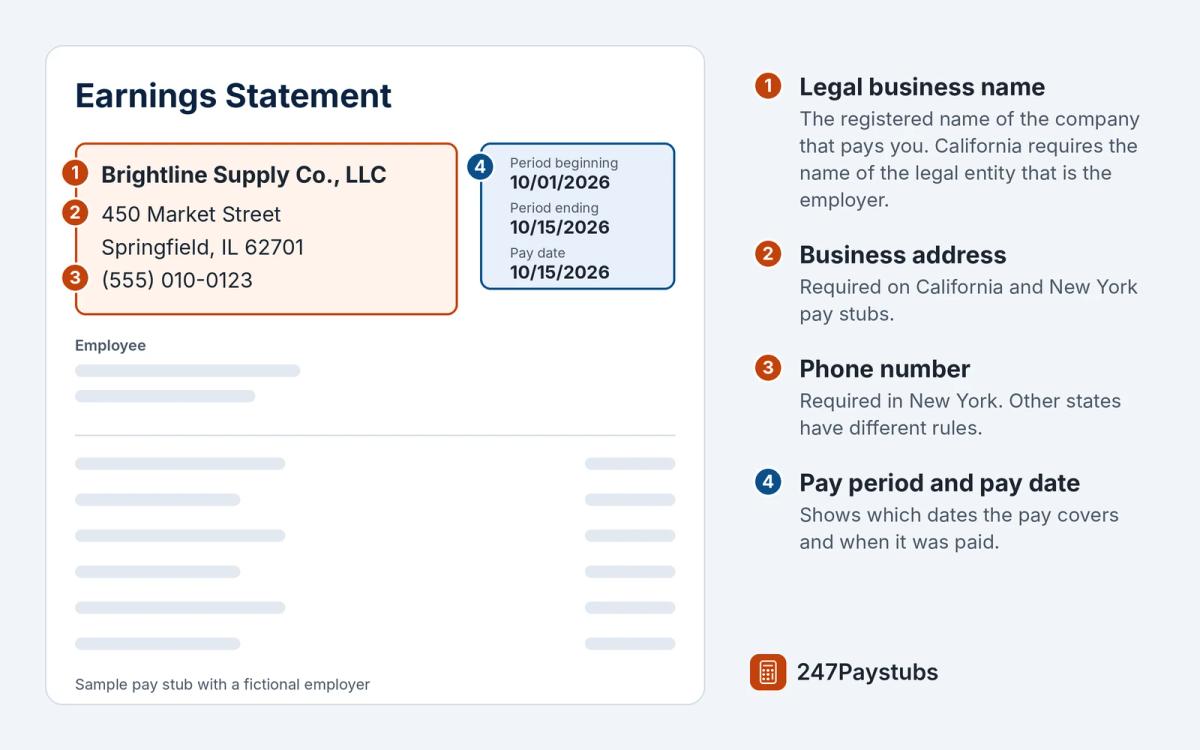
The employer’s legal name
The stub should show the legal name of the company that pays you. California, for example, requires “the name and address of the legal entity that is the employer.” That name can differ from the brand name customers see.
The employer’s address
California and New York both require the employer’s address on the pay stub. Most employers print their main business address.
The employer’s phone number
New York also requires the employer’s phone number. California’s list of required items does not include one. Many employers print a phone number anyway, so workers know whom to call with questions.
Does Federal Law Require Employer Details on a Pay Stub?
Generally, no. The federal Fair Labor Standards Act requires employers to keep payroll records for non-exempt workers. Those records cover hours, wages, deductions, the pay period, and the payment date.
However, the Department of Labor’s recordkeeping guidance for the FLSA does not list the employer’s name or address. It also does not say that employers must hand workers a pay stub. Payroll records must be kept for at least three years. That leaves the details to the states.
What Do State Laws Say About Employer Information on a Pay Stub?
State rules vary a lot. Some states have detailed lists. Others do not require a pay stub at all. Here is how two large states compare:

Based on California Labor Code § 226(a) and New York State Department of Labor guidance. Other states differ.
You can read the full rules in California Labor Code section 226 and on the New York State Department of Labor wage statement page. For any other state, check with that state’s labor department.
Which state’s rules apply to you?
Usually, it is the state where you do the work, not where your employer has its headquarters. If you are unsure, ask your state labor department.
Are there special rules for certain employers?
Yes, some states add extra items for specific industries. In California, a farm labor contractor must also show the name and address of the legal entity that secured its services. A temporary staffing employer must show the pay rate and total hours for each assignment.
If you work for a staffing agency or contractor, look closely at the employer’s name on your stub. It may be the agency, not the company where you do the work.
Does a Pay Stub Need the Employer’s EIN?
Usually not. California’s list of required items does not include an Employer Identification Number (EIN), and New York’s wage statement guidance does not either.
Your employer’s EIN appears on your Form W-2 instead. Some employers print it on pay stubs as well. If yours does, nothing is wrong.
What Other Information Must Appear on a Pay Stub?
Employer details are only one part of the stub. State rules commonly require these items too:
- Your name, and in California the last four digits of your Social Security number or an employee ID
- The dates the pay period covers
- Hours worked and pay rates, for hourly workers
- Gross wages
- Deductions
- Net wages
Every stub shows both gross pay and net pay. If those terms are confusing, read our guide on the difference between gross pay and net pay.
Why Does Employer Information on a Pay Stub Matter?
The employer section may look like small print, but it does real work.
- Proof of income. Lenders and landlords often check the employer’s name and contact details when they verify your income.
- Accuracy. A name that does not match your Form W-2 can cause problems when you file taxes or apply for a loan.
- A clear record. If you ever have a pay dispute, the stub shows exactly who paid you and for which dates.
What happens if the employer information is wrong?
A wrong name or address is often a simple clerical error. It still deserves a quick fix. Lenders may question the document, and your tax records may not line up.
If the mistake is in the payroll system, one correction usually repairs every future stub.
How Can You Check That Your Pay Stub Is Complete?
Use this quick check on each new stub:
- Find the employer’s name. Make sure it is the company you work for.
- Look for the address. It should be a real business address.
- Check for a phone number. It may be required in your state, or it may just be helpful.
- Confirm the dates. The pay period and pay date should match your schedule.
- Compare with your last stub. The employer details should stay the same each time.
If something is missing, ask your payroll or HR team to fix it. A missing detail is not always a legal problem, but it is worth asking about. If your employer does not respond, contact your state labor department.
What common errors should you watch for?
- The stub lists a payroll service provider instead of your employer.
- The company name is different from your offer letter, often after a rename or merger.
- The address is out of date after the business moved.
- The employer details change from one stub to the next without a reason.
When in doubt, ask HR which legal entity employs you. Then check that the name matches your Form W-2 at tax time.
What Should Employers Do to Create Compliant Pay Stubs?
If you run a business, a few habits keep your stubs accurate and consistent:
- Print your registered legal name, not only your brand name.
- Keep your address and phone number up to date.
- Check the wage statement rules in every state where you have employees.
- Keep payroll records for at least the federal minimum of three years, and longer if your state requires it.
Our step-by-step guide to creating a pay stub shows where each item belongs. You can also see a finished layout with our online pay stub generator.
Pay stubs must reflect real earnings. Using false pay stubs to get a loan, housing, or benefits is illegal.
What Should You Remember About Employer Information on a Pay Stub?
Federal law does not set a list of employer details for pay stubs. State laws do, and they differ. The employer’s legal name and address are the most common requirements, and some states add a phone number.
Employer Information on a Pay Stub FAQs
Does the employer’s address have to be on a pay stub?
In California and New York, yes. Other states have different rules, and some do not require pay stubs at all. Check your state labor department’s guidance.
Is the EIN required on a pay stub?
Usually not. Neither California’s law nor New York’s guidance lists the EIN as a required item. Your employer’s EIN is shown on your Form W-2.
Can an employer use a business nickname on a pay stub?
Some states require the legal name of the employer. In California, the stub must show the name of the legal entity that is the employer. A brand name alone may not meet that rule.
What should I do if my pay stub is missing employer information?
Ask your payroll or HR team to correct it and send a new stub. If your employer does not respond, contact your state labor department. They can tell you what your state requires.
Do pay stubs have to be on paper?
Not always. Many states allow electronic pay stubs, but the rules differ. Some require employee consent or access to a printer.
How long should employers keep payroll records?
Under federal rules, employers must keep payroll records for at least three years. Some states require longer. Employers should check their state’s rule.

Ken Woods is a certified accountant and payroll expert with over 10 years' experience in the field.